
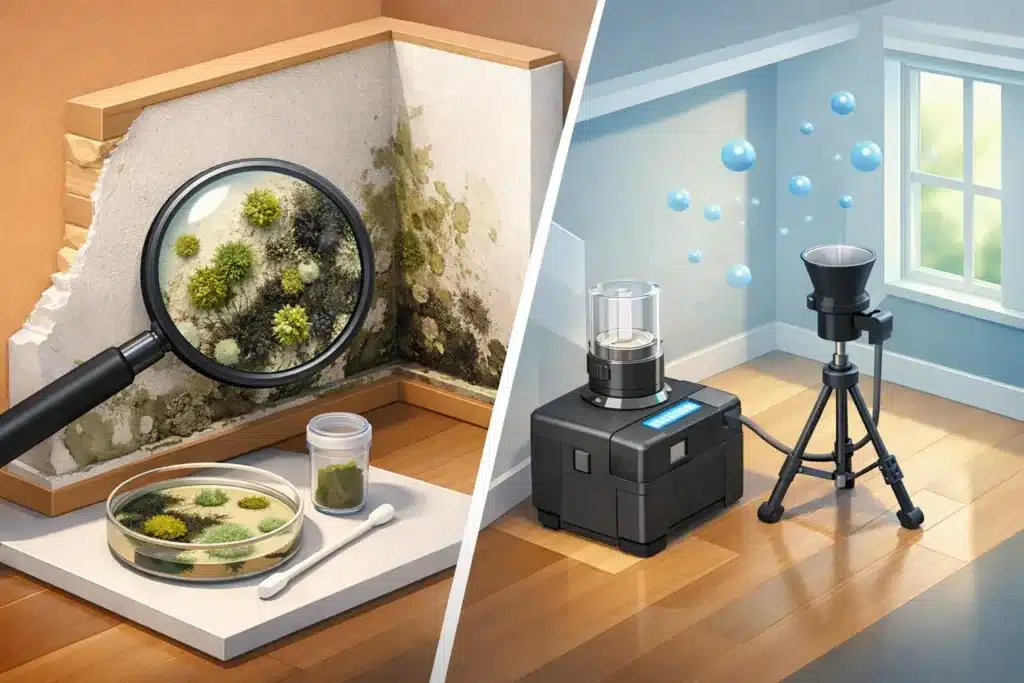
A musty closet, a past roof leak, or symptoms that seem to worsen at home can leave you searching for a clear answer. But indoor mold testing versus air sampling is not always an either-or decision. Air sampling is one type of environmental mold test, and it can be useful in the right situation. It is simply not designed to answer every question.
For people dealing with persistent fatigue, headaches, sinus irritation, brain fog, skin concerns, or symptoms that do not make sense despite repeated efforts to feel better, the goal is bigger than getting a test result. The goal is to understand whether a building may be contributing to your total toxic burden, what evidence is meaningful, and what practical next step will protect your health.
Indoor Mold Testing Versus Air Sampling: The Key Difference
Indoor mold testing is a broad term. It may include visual assessment, moisture investigation, surface samples, dust analysis, or air samples. Each method looks at a different part of the indoor environment.
Air sampling collects a measured volume of air, usually indoors and sometimes outdoors for comparison. A laboratory examines the sample for mold spores and may report the types and concentrations found. It offers a snapshot of what was airborne at the precise time and place the sample was collected.
That snapshot can be valuable, especially when there is an active moisture problem, visible growth, recent disturbance of contaminated materials, or a concern that spores are moving through an HVAC system. Yet a normal air sample does not automatically rule out a hidden mold problem. Mold growth behind a wall, under flooring, inside a ceiling cavity, or beneath cabinetry may release spores inconsistently. A closed door, a recently cleaned room, weather conditions, filtration, and the timing of the test can all change what the sampler captures.
A broader indoor mold assessment asks a more useful question: where has water entered, where is moisture being retained, and what evidence is present in the building over time?
What Air Sampling Can Tell You
When performed thoughtfully, air sampling can help identify elevated airborne spores in a specific area. It may reveal an unusual indoor mold pattern compared with outdoor air or other rooms. This can support a decision to investigate further, particularly when the property has a known leak, a strong odor, or visible water damage.
Air sampling may also be appropriate after remediation. If contaminated materials were removed and the work area was properly contained, post-remediation air testing can be one piece of a larger clearance process. It is most useful when combined with a careful visual inspection and confirmation that the moisture source has been corrected.
The limitation is that air is constantly changing. A sample collected on a calm afternoon with the air conditioning running is not the same as a sample collected after a storm, during renovation, or after opening a wall. A low spore count may reflect low airborne activity at that moment, not necessarily a clean building.
This matters in humid parts of Texas, where condensation, HVAC issues, plumbing leaks, and storm-related water intrusion can create conditions for concealed growth. If the history and the building conditions suggest a moisture issue, a single reassuring air result should not end the investigation.
When a Dust or Surface Test May Be More Helpful
Settled dust can preserve a longer-term record of what has circulated through an indoor space. A dust-based mold building profile may be worth considering when someone suspects a chronic exposure but air samples are inconsistent or the concern involves hidden contamination. Dust testing can help show patterns that a brief air sample may miss.
This does not mean dust testing is automatically the best choice for every home. Results can be influenced by cleaning habits, the age of dust, open windows, pets, and how the sample was collected. Still, when interpreted alongside the building history, visible conditions, and health picture, it can provide meaningful context.
Surface sampling has a different purpose. A swab or tape lift can help identify suspected growth on a material. It may be useful when discoloration is present but it is unclear whether the area is mold, dirt, or another substance. It does not, however, tell you how much mold may be hidden elsewhere or how much is in the air.
In many cases, the most revealing “test” is a detailed moisture-focused inspection. Finding elevated moisture in drywall, a leaking drain line, staining inside a cabinet, or a poorly draining exterior area can explain why mold is present and why it may return. Testing without identifying the water source can lead to more questions than answers.
Why Symptoms and Building Results Need Context
Mold concerns are understandably personal. People may notice that they feel worse at home, in a particular room, or after a water event. Others have a known exposure history but no obvious symptoms. Neither experience should be dismissed.
At the same time, symptoms alone cannot confirm mold exposure, and an environmental test alone cannot establish why a particular person feels unwell. Fatigue, headaches, digestive discomfort, mood changes, sleep disruption, and respiratory symptoms can have many contributing factors. Nutrient deficiencies, hormone patterns, gut health, food reactions, stress load, sleep quality, other environmental exposures, and underlying health conditions may all deserve attention.
A whole-person approach recognizes that health is rarely explained by one data point. If a home has a moisture problem, addressing the environment is foundational. Supporting the body with nutrition, hydration, restorative sleep, and individualized wellness care can also matter, especially for people who feel depleted after a prolonged environmental stressor.
For some clients, mycotoxin screening may be considered as part of a broader root-cause assessment. This type of testing is different from testing a home. It may provide information about certain mold-related compounds detected in a biological sample, but it does not identify the source of exposure or prove that a particular building is responsible. It is best used with clinical context rather than as a stand-alone answer.
How to Choose the Right Next Step
Start with the building story. Was there a roof leak, plumbing failure, flood, recurring condensation, sewage backup, or HVAC issue? Is there a persistent musty odor, peeling paint, warped flooring, staining, or an area that feels damp? These details often matter more than an isolated number on a lab report.
If there is visible mold covering more than a small area, extensive water damage, or concern about contamination inside walls or HVAC components, a qualified indoor environmental professional or remediation specialist may be needed. The priority is to identify and correct the moisture source, contain affected materials when appropriate, and avoid disturbing suspected growth without a plan. Spraying fragrance, bleach, or a surface cleaner over a hidden moisture problem does not resolve what is feeding it.
Air sampling can be a sensible choice when you need to evaluate current airborne conditions, compare areas, or document conditions after remediation. A dust-based building profile may offer more insight when you are looking for evidence of a longer-term pattern. Surface sampling can help characterize a suspicious material. Often, the strongest approach combines targeted testing with an experienced inspection rather than relying on one method alone.
Be cautious of two extremes: the claim that every mold test is meaningless, and the claim that one elevated result explains every health concern. Both shortcuts can keep you from making a clear, grounded decision. Good assessment looks at the property, the quality of the sample, the timing, your health history, and the next action the result can reasonably support.
A More Grounded Path Forward
If you have ongoing symptoms and suspect your indoor environment may be part of the picture, begin by documenting water events, odors, and the rooms where symptoms seem worse. Take note of improvements when you are away from the space, but do not rely on that observation alone. Pair environmental investigation with personalized health support so you are not left trying to interpret complicated results by yourself.
At Houston Holistic Health Clinic, we believe you deserve thoughtful guidance that looks beyond symptom suppression. The right test is not necessarily the most extensive one. It is the one that helps clarify your next step, supports a root-cause investigation, and moves you closer to a healthier place to live and heal.
